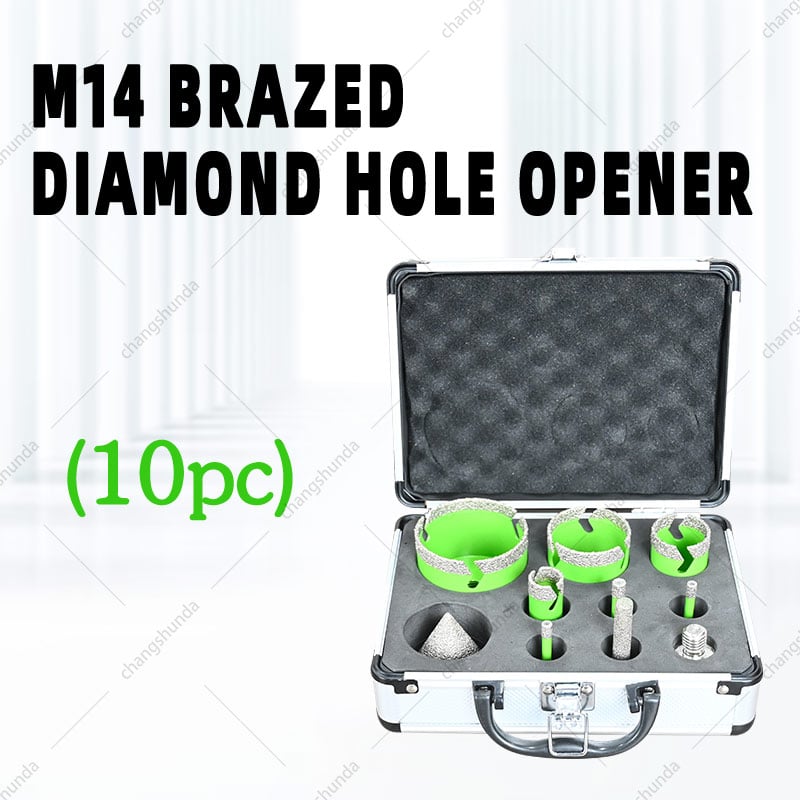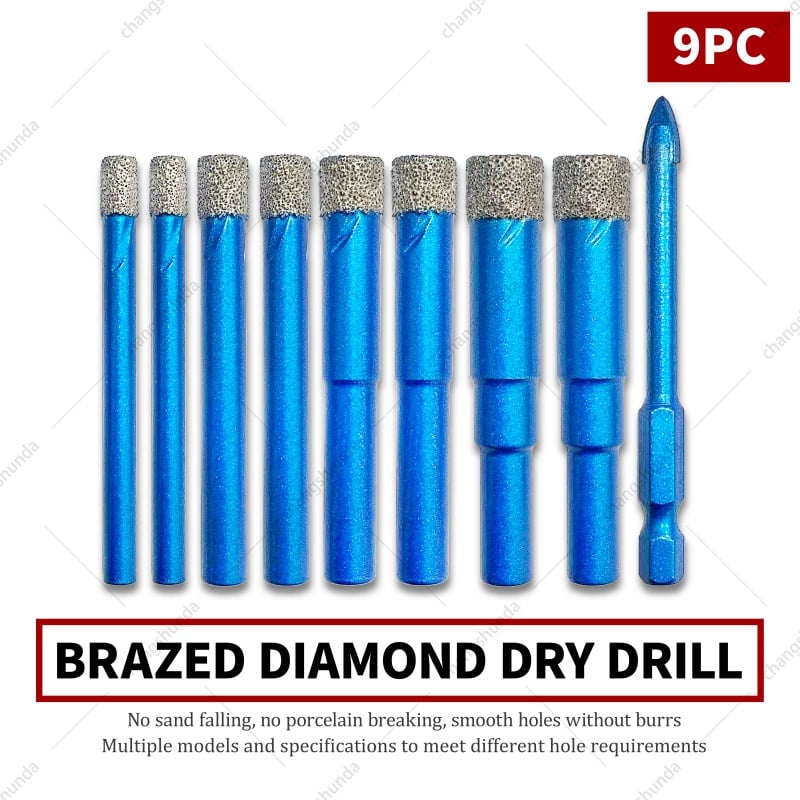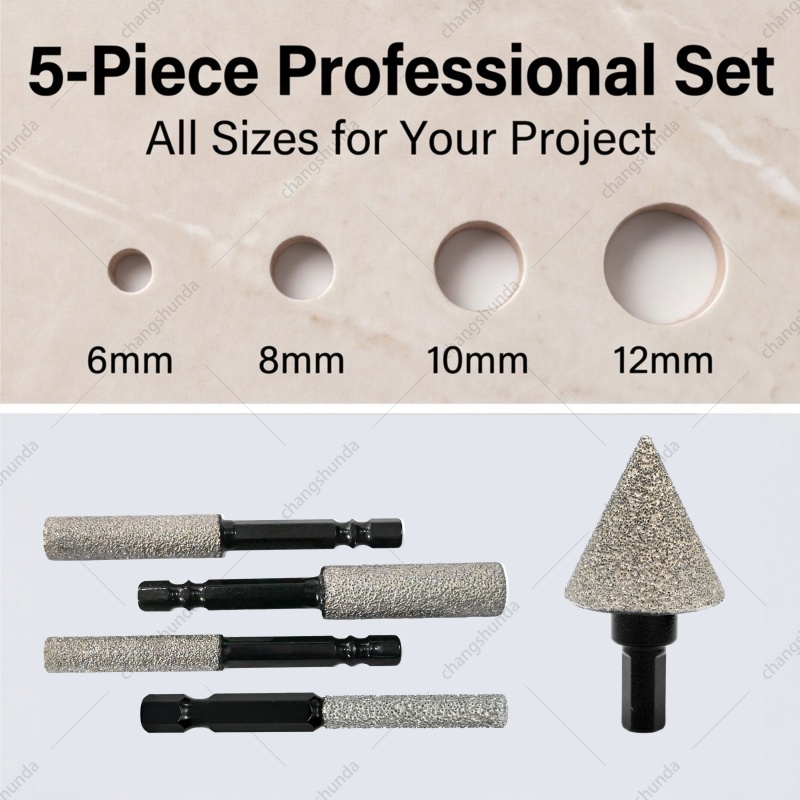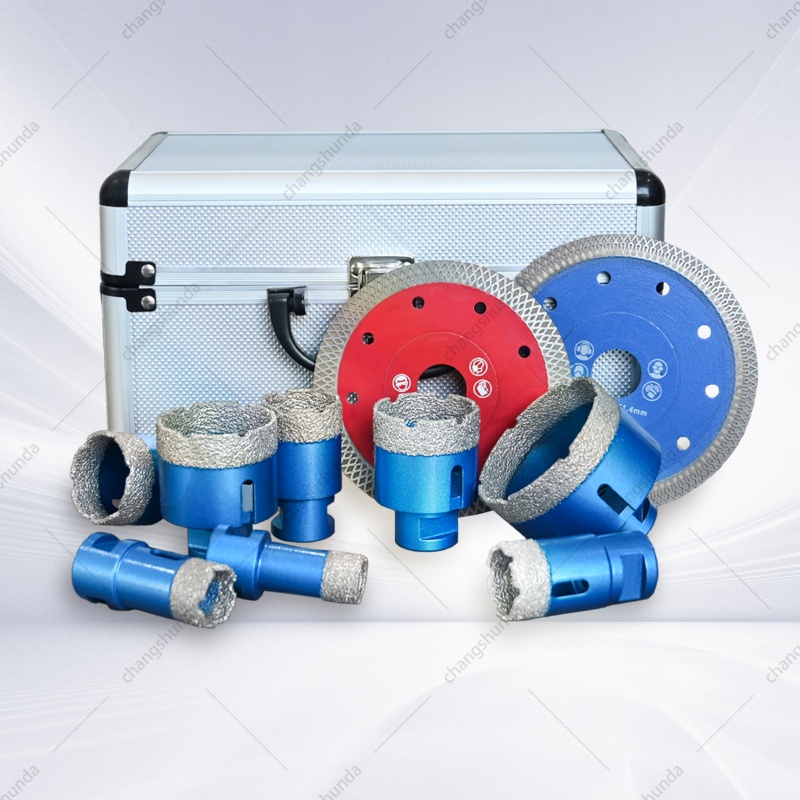
Jishan County, Shanxi — September 13, 2026 — Jishan County Changshunda Diamond Tools Co., Ltd. brought its technical staff, production line leaders and core sales backbone into the same room this month to answer one question about its newest release: how does the three-hole anti-jam diamond core bit move from the process line to the customer's job site at the right cost, the right quality level and the right speed? The meeting was chaired by Xinbo Hui, Technical Director, and attended by more than twenty team members from R&D, production, quality control, domestic sales and export operations.

The answer, as it turned out, came down to two design decisions — multi-hole evacuation and an internal step design — and to whether production and sales could agree on the numbers behind them.
Every contractor who has drilled porcelain tile or granite with a diamond core bit knows the failure mode. The bit cuts well for the first few holes, then the core plug wedges itself inside the barrel. The operator stops, reaches for a screwdriver or a hammer, and spends two to three minutes fighting the tool instead of cutting. On a bathroom renovation with forty holes to drill, that lost time is measured in hours — and every hammer strike risks distorting a barrel that has to stay true to hold its tolerances.
The problem is rarely the diamond segment. It is almost always the space between the segment and the arbor: slurry that cannot escape, friction that builds against the barrel wall, and nowhere for the core plug to go when the hole is finished. An anti-jam core bit has to solve those three points together, which is why Changshunda's technical team opened the meeting with those two features rather than with the segment itself.
Multi-hole evacuation
Instead of a single narrow cooling slot, the new series carries a multi-hole evacuation layout — three evacuation ports positioned to move slurry and fine debris out of the cutting zone as fast as the water carries it in. The practical effects show up in three places:
· Lower cutting temperature. Coolant reaches the cutting edge instead of channelling past a blocked port, so the segment runs cooler and holds its bond longer.
· Faster penetration. Debris that leaves the cut immediately cannot be re-ground by the segment, so more of the motor's energy goes into cutting rather than into re-grinding.
· Fewer blocked ports. With three paths instead of one, a partial blockage in one port does not shut down the flow of coolant — a common cause of sudden segment burn on deep cuts.
Internal step design
The second feature is less visible and, according to the technical team, does most of the work. The internal step design puts a machined step inside the barrel rather than a straight bore wall. That step changes how the core plug behaves in two ways: it reduces the contact area between the plug and the barrel wall, which is the surface that creates the wedging friction, and it gives the plug a defined release point instead of allowing it to ride up the full length of the barrel.
In practice, this is what converts a bit that has to be cleared with a hammer into a bit whose core drops out with a light push — the "no core jam" behaviour the sales team has been asked about most often since the first samples went out.
Proving it on site, not on paper
The team was direct about the limits of laboratory data. A core bit is only proven when it holds its performance on the hundredth hole, on a material the customer actually cuts. The launch batch therefore went out with a clear application scope — porcelain tile, ceramic wall tile, granite, engineered stone and glass, wet cutting as standard — plus a printed maximum RPM for each diameter, and dry-cutting limits marked only where the product allows it.
The technical side then walked the room through production readiness, item by item against drawings and test records:
· Segment bonding and wall thickness. Brazing quality and segment-to-body bond strength were reviewed across the current batch, and the control points for wall thickness tolerance on the 8 mm–100 mm diameter range were frozen.
· Concentricity and runout. Runout at the pilot drill and at the cutting edge was measured on both M14 and 5/8"-11 arbor versions. Off-centre rotation is the most common cause of chipped edges on porcelain and hard stone, and it is the first thing a distributor's customers will notice.
· Cooling geometry. Water-feed layout was re-verified against the multi-hole evacuation design for wet cutting on ceramic tile, granite and engineered stone.
· Substrate and marking. Body steel grade, surface treatment and the laser-marked specification set — diameter, arbor, application icon, maximum RPM — were frozen for the launch batch.
Ten production cells are now qualified for the new series. First-pass yield on the pilot batch stood at 85%, a figure the team committed to lift to 96% within ten days of the meeting.
The commercial side then reversed the flow of information, bringing customer feedback into the same room:
· Field feedback. Early users in the United States and other export markets highlighted cutting speed and clean edges on porcelain, and asked for shorter lead times on the fastest-moving diameters.
· Pricing and positioning. The team compared the series against competing thin-wall bits and agreed a price ladder covering OEM/ODM, private label and own-brand channels.
· Channel plan. Distribution will run on three tracks: the independent website for brand and direct enquiries, B2B marketplaces for volume orders, and regional distributors for local stock and technical support.
· Packaging and documentation. Box artwork, the bilingual specification sheet, the cutting-application guide and QR-linked product pages were each assigned an owner and a delivery date, so the marketing assets land with the first shipment rather than after it.
| No. | Action | Owner | Target date |
| 1 | Freeze process parameters for the launch batch and issue the work instruction | Technical / Production | Sep 16 |
| 2 | Complete durability testing on porcelain and granite, publish the test data sheet | Quality | Sep 17 |
| 3 | Finalise the diameter matrix and SKU list for launch | Technical / Sales | Sep 18 |
| 4 | Publish product pages, spec sheet and application guide on the independent website | Marketing | Sep 20 |
| 5 | Open quotations for the first distributor and bulk enquiries | Sales | Sep 20 |
| 6 | Collect first-batch customer feedback and route it back to R&D | Sales / Technical | Sep 20 |
"New products are never finished by the technical department alone," said Cheng Jiangyan, Production Supervisor, in the concluding session. "A core bit only proves itself when it cuts cleanly on a customer's site and still performs on the hundredth hole. That is why the people who make it and the people who sell it have to sit at the same table, in the same room, with the same numbers."
Why does my diamond core bit get stuck in porcelain tile?
Most jamming comes from debris that cannot leave the cut. Slurry builds up between the core plug and the barrel wall, friction rises, and the plug wedges. A multi-hole evacuation design moves that slurry out faster, and an internal step design reduces the contact area that creates the friction.
What does "multi-hole evacuation" actually change?
It gives the coolant more than one path out of the cutting zone. If one port partly blocks, flow continues through the others, so the segment keeps running cool instead of burning. The visible results are faster penetration, longer segment life and fewer stopped cuts.
Does an internal step design affect drilling speed?
It is not a speed feature. It changes how the core plug behaves inside the barrel. Because the plug contacts less of the barrel wall and has a defined release point, it drops out with a light push rather than needing to be driven out with a hammer — which also protects the barrel's concentricity.
Which arbors and diameters does the new series cover?
The launch range runs from 8 mm to 100 mm in diameter with M14 and 5/8"-11 arbors. Sizes outside the standard matrix can be quoted on request for OEM and private-label programmes.
Send us your application and we will come back with the diameter, arbor and segment specification for the anti-jam core bit that fits it. To quote accurately we need five things: the material you are drilling, the diameter, the arbor type (M14 or 5/8"-11), whether you drill wet or dry, and your order quantity. Tell us these and you will get a quotation with lead time and MOQ, not a generic price list.
Contact: Ya Qin · [email protected] · +86 13705784455
Changshunda is a manufacturer of diamond tools based in Qinghe Town, Jishan County, Shanxi Province, China, within the region's superhard materials industrial cluster. The company produces three-hole anti-jam diamond core bits, diamond grinding and cutting discs, woodworking saw blades and related tools for tile, stone, glass and construction applications, serving distributors, contractors and importers through OEM/ODM, private label and own-brand channels.
 Hot News
Copyright © Jishan County Changshunda Diamond Cutting Tools Co., Ltd. All Rights Reserved - Privacy Policy
 EN